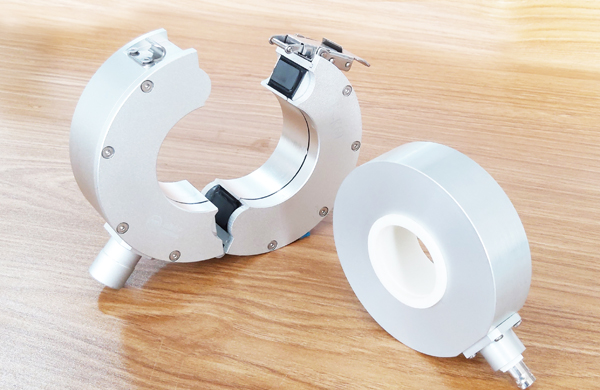
Partial Discharge Current Sensors Image 1

Partial Discharge Current Sensors

Applications

  • Switchgear
  • Protection for power generator and transformer

Features

  • Quick response in nanoseconds
  • Wide working frequency range: 100kHz - 50MHz
  • High accuracy
  • Easy installation
  • IP68 waterproof
  • Sensitivity: 5pC
  • Output electrical impedance: 50Ω
  • Output connector: BNC connector, or specified by user
  • Operating temperature: -40℃~+85℃
Download Datasheet

Product Overview

YuanXing Electronics’ Partial Discharge Current Sensors are high-frequency current transformers (HFCTs) designed for the non-invasive online monitoring of insulation in critical high-voltage assets. These precision partial discharge sensors detect transient currents emitted by PD activity within cables, GIS, and transformers. The PD sensor provides the high precision measurements needed for a predictive maintenance strategy by allowing for the early identification of faults before a failure occurs. The structures allow to improve the reliability and safety of power systems.

Typical Products

Image Part Number Rated Input (A) Turn Ratio Frequency (Hz) Secondary Burden (Ω) Accuracy Class Dimensions (mm) PDF
Partial Discharge Current Sensors Image 1 TA1111 5~30 1000:1
2000:1
2500:1
50 to 400 ≤200 0.1
0.2
0.5
ID-L-W-H 7.0-22.0-18.0-23.0
Partial Discharge Current Sensors Image 2 TA1311 5~80 1000:1
2000:1
2500:1
50 to 400 ≤800 0.1
0.2
0.5
ID-L-W-H 7.0-22.0-18.0-23.0
Image Part Number Rated Input (A) Turn Ratio Frequency (Hz) Secondary Burden (Ω) Accuracy Class Dimensions (mm) PDF
Partial Discharge Current Sensors Image 3 CTT0150 5-150 1:1000
1:2000
1:3000
1:5000
50 to 400 50-400 0.1
0.2
15-58-23-45

Frequently Asked Questions

Honeywell needed a stable and highly accurate way to measure current fluctuations in large commercial buildings. Existing sensors often produced noise and drifted over time, creating errors in smart energy dashboards

Honeywell needed a stable and highly accurate way to measure current fluctuations in large commercial buildings. Existing sensors often produced noise and drifted over time, creating errors in smart energy dashboards

Honeywell needed a stable and highly accurate way to measure current fluctuations in large commercial buildings. Existing sensors often produced noise and drifted over time, creating errors in smart energy dashboards

Honeywell needed a stable and highly accurate way to measure current fluctuations in large commercial buildings. Existing sensors often produced noise and drifted over time, creating errors in smart energy dashboards

Honeywell needed a stable and highly accurate way to measure current fluctuations in large commercial buildings. Existing sensors often produced noise and drifted over time, creating errors in smart energy dashboards