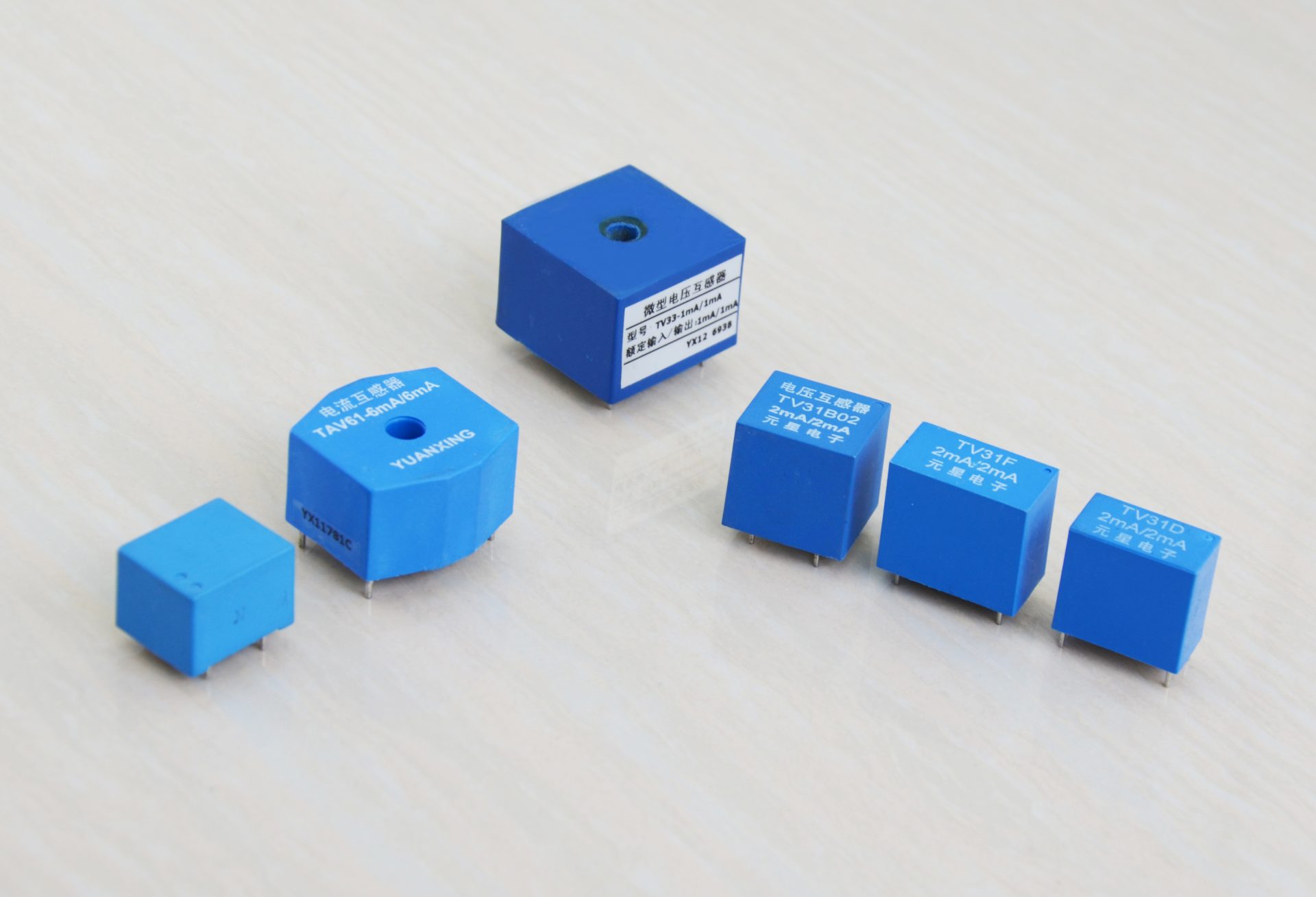
| Image | Part Number | Rated Input / Output | Frequency (Hz) | Secondary Burden Resistance (Ω) | Accuracy Class | Dimension (mm) |
|---|---|---|---|---|---|---|
| TV31B | 1mA/1mA or 2mA/2mA | 50 to 400 | ≤500 | 0.1 or 0.2 |
L-W-H 19-17.0-18.3 |
|
| TV31D | 2mA/2mA | 50 to 400 | ≤150 | 0.1 or 0.2 |
L-W-H 19.5-10.5-18.0 |
|
| TAV61 | 6mA/6mA | 50 to 400 | ≤400 | 0.2 |
L-W-H 26.5-25.5-15 |
|
| TV31E | 2mA/2mA | 50 to 400 | ≤150 | 0.1 or 0.2 |
L-W-H 18.8-16.2-13.4 |
|
| TV31F | 2mA/2mA | 50 to 400 | ≤200 | 0.1 or 0.2 |
L-W-H 22.0-12.0-19.0 |
|
| TV33 | 3mA/0.75mA | 50 to 400 | ≤1000 | 0.1 or 0.2 |
L-W-H 28.0-20.0-28.0 |
Frequently Asked Questions
Current transformers/sensors, voltage transformers/sensors, and Rogowski coils from Yuanxing are widely adopted across the following industries:
Electric Power Grids, Renewable Energy, Rail Transit, Industrial Automation & Motor Control, Aerospace, Data Centers, Telecommunications.
Yes. Our in-house R&D and engineering teams can support customized current/voltage transformers, Rogowski coil and current/voltage sensor designs, including special ratios, form factors, output signals, and mounting requirements.
Yes. We can supply detailed product specifications, datasheets, and wiring/application notes for each standard or customized configuration.
Yes. With over 20 years of export experience, we serve customers worldwide and provide full sales and logistics support for both small-quantity orders and large-volume projects.
Please submit an inquiry via email or our online contact form. For selected products, we can provide free samples; shipping will be arranged using your courier account (e.g., DHL / FedEx / UPS).