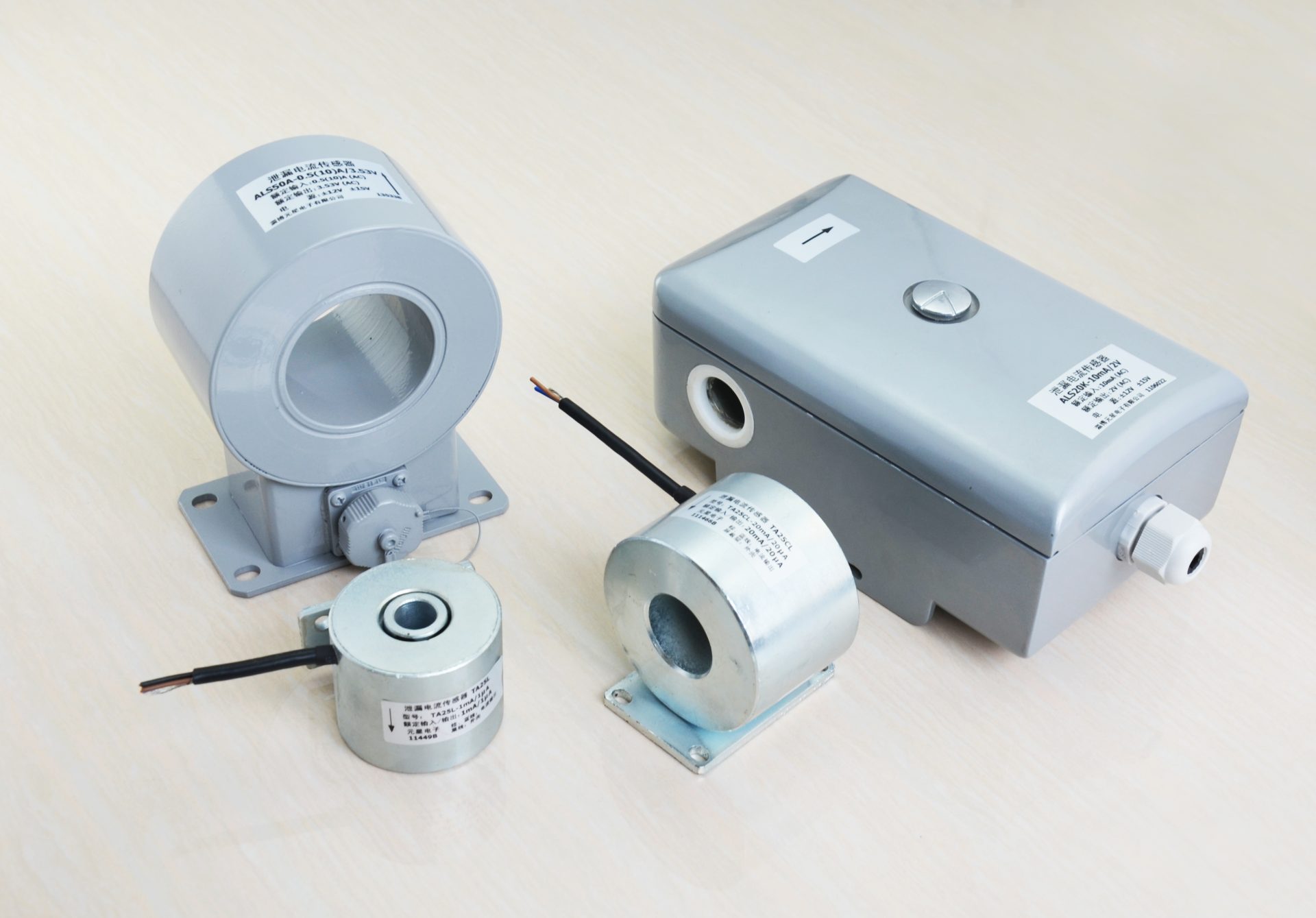
AC Leakage Current Transducers Image 1

AC Leakage Current Transducers

Applications

  • Power supplies
  • Industrial automation
  • Frequency converter
  • Motor drive
  • Railway signal
  • Rectifier

Features

  • Input can be AC or DC current; output is DC signal
  • AC measuring frequency: 50Hz - 400Hz
  • Responding time: <350ms
  • Linearity: 0.5%
  • Waterproof
  • Zero insertion loss
  • Low power consumption
Download Datasheet

Specifications

Product Overview

YuanXing Electronics’ AC leakage current transducers are high-precision components engineered for insulation monitoring in high-voltage power grids. Utilizing advanced electromagnetic induction, these transducers detect minute leakage currents ranging from 0.5mA to 700mA. They feature a robust metal case for anti-interference and electromagnetic shielding. With an amplitude error of ±0.1% and phase error of ±1′, they ensure exceptional data accuracy. These units convert signals into standard industrial DC outputs (0-5V or 4-20mA), facilitating seamless integration with PLCs and monitoring systems.

Typical Products

Image Part Number Rated Input (A) Turn Ratio Frequency (Hz) Secondary Burden (Ω) Accuracy Class Dimensions (mm) PDF
AC Leakage Current Transducers Image 1 TA1111 5~30 1000:1
2000:1
2500:1
50 to 400 ≤200 0.1
0.2
0.5
ID-L-W-H 7.0-22.0-18.0-23.0
AC Leakage Current Transducers Image 2 TA1311 5~80 1000:1
2000:1
2500:1
50 to 400 ≤800 0.1
0.2
0.5
ID-L-W-H 7.0-22.0-18.0-23.0
Image Part Number Rated Input (A) Turn Ratio Frequency (Hz) Secondary Burden (Ω) Accuracy Class Dimensions (mm) PDF
AC Leakage Current Transducers Image 3 CTT0150 5-150 1:1000
1:2000
1:3000
1:5000
50 to 400 50-400 0.1
0.2
15-58-23-45

Frequently Asked Questions

Honeywell needed a stable and highly accurate way to measure current fluctuations in large commercial buildings. Existing sensors often produced noise and drifted over time, creating errors in smart energy dashboards

Honeywell needed a stable and highly accurate way to measure current fluctuations in large commercial buildings. Existing sensors often produced noise and drifted over time, creating errors in smart energy dashboards

Honeywell needed a stable and highly accurate way to measure current fluctuations in large commercial buildings. Existing sensors often produced noise and drifted over time, creating errors in smart energy dashboards

Honeywell needed a stable and highly accurate way to measure current fluctuations in large commercial buildings. Existing sensors often produced noise and drifted over time, creating errors in smart energy dashboards

Honeywell needed a stable and highly accurate way to measure current fluctuations in large commercial buildings. Existing sensors often produced noise and drifted over time, creating errors in smart energy dashboards