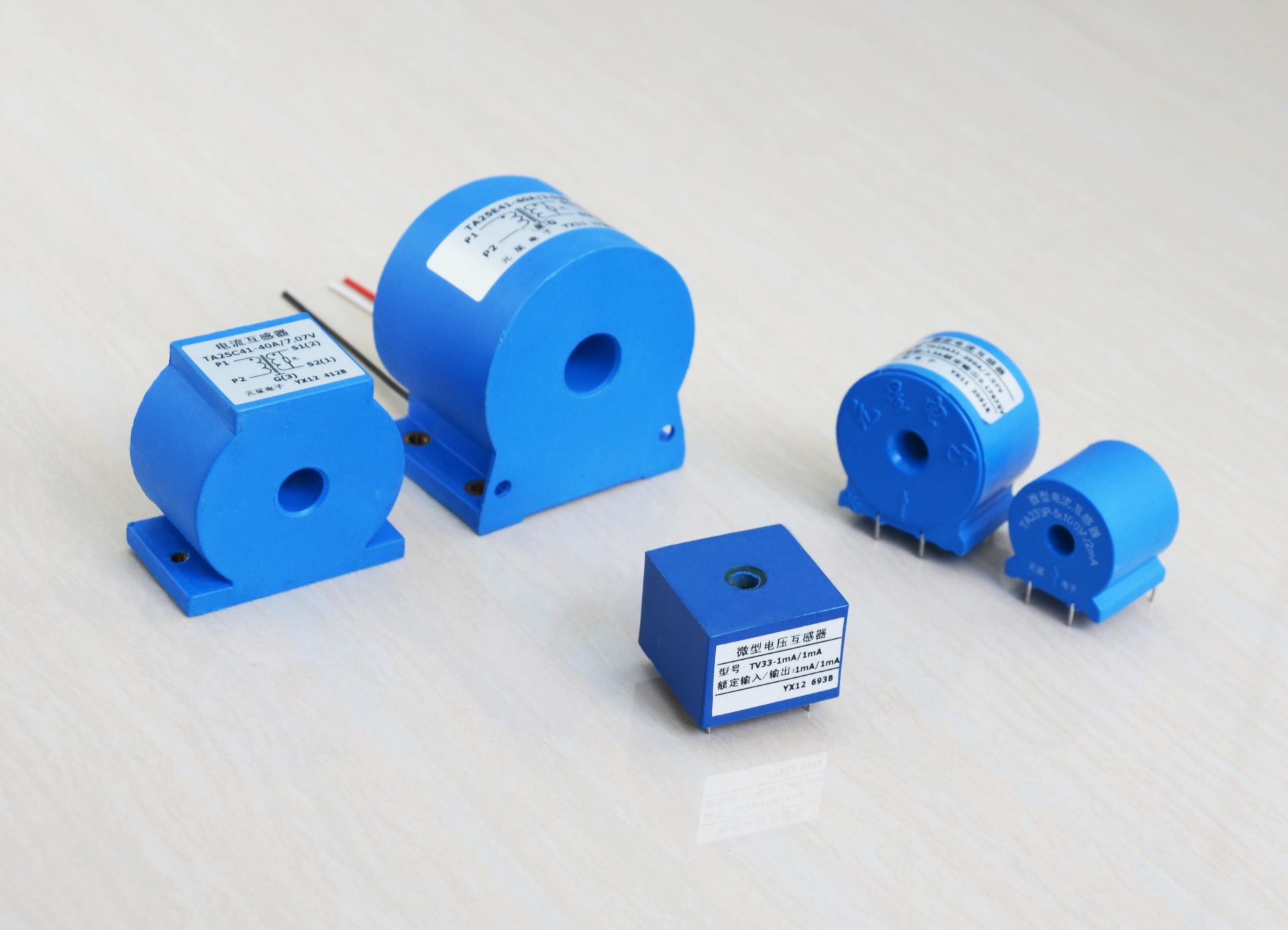
| Image | Part Number | Rated Input Current (A) | Ratio | Secondary Burden Resistance (Ω) | Accuracy Class | Dimension (mm) | Mounting |
|---|---|---|---|---|---|---|---|
| TA23B71 | 5 / 10 / 20 | 1000:1 / 2000:1 | ≤50 | 0.02 / 0.05 |
ID-L-W-H 6.0-26.0-22.0-27.0 |
Soldering | |
| TA3371 | 5 / 10 / 20 | 1000:1 / 2000:1 | ≤50 | 0.02 / 0.05 |
ID-L-W-H 7.0-28.0-28.0-22.0 |
Soldering | |
| TA23A71 | 5 / 10 / 20 | 1000:1 / 2000:1 | ≤50 | 0.02 / 0.05 |
ID-L-W-H 6.0-34.0-22.0-36.0 |
Soldering | |
| TA25F71 | 5 / 10 / 20 / 40 / 60 | 1000:1 / 2000:1 | ≤50 | 0.02 / 0.05 |
ID-L-W-H 15.0-58.0-23.0-45.0 |
Screw | |
| TA25B71 | 5 / 10 / 20 / 40 / 80 | 1000:1 / 2000:1 / 3000:1 | ≤100 | 0.02 / 0.05 |
ID-L-W-H 11.5-53.0-27.0-46.0 |
Screw | |
| TA5571 | 5 / 10 / 20 / 40 / 80 | 1000:1 / 2000:1 / 3000:1 / 4000:1 | ≤100 | 0.02 / 0.05 |
ID-OD-H 12.7-65.0-35.0 |
N/A | |
| TA25E71 | 5 / 10 / 20 / 40 / 80 | 1000:1 / 2000:1 / 3000:1 | ≤100 | 0.02 / 0.05 |
ID-L-W-H 12.7-50.0-38.0-55.0 |
Screw |
| Image | Part Number | Rated Input Current (A) | Ratio | Secondary Burden Resistance (Ω) | Accuracy Class | Dimension (mm) | Mounting |
|---|---|---|---|---|---|---|---|
| TA23B71 | 1.5 / 5 / 6 | 1000:1 / 2000:1 | ≤50 | 0.02 / 0.05 |
L-W-H 25.0-21.5-26.0 |
Soldering | |
| TA5671 | 1 / 2 / 5 / 10 | 1000:1 / 2000:1 | ≤100 | 0.02 / 0.05 |
OD-H 45.0-35.0 |
Soldering | |
| TA54A71 | 1 / 2 / 5 / 10 | 1000:1 / 2000:1 | ≤100 | 0.02 / 0.05 |
OD-H 40.0-31.0 |
Soldering | |
| TA63E71 | 1 / 2 / 5 / 10 / 20 | 1000:1 / 2000:1 / 3000:1 | ≤100 | 0.02 / 0.05 |
OD-H 40.0-33.5 |
Screw | |
| TA5571 | 1 / 2 / 5 / 10 / 20 | 1000:1 / 2000:1 / 3000:1 | ≤100 | 0.02 / 0.05 |
ID-OD-H 12.7-65.0-35.0 |
N/A | |
| TA25E71 | 1 / 2 / 5 / 10 / 20 | 1000:1 / 2000:1 / 3000:1 / 4000:1 | ≤100 | 0.02 / 0.05 |
L-W-H 50.0-38.0-55.0 |
Screw |
Frequently Asked Questions
Honeywell needed a stable and highly accurate way to measure current fluctuations in large commercial buildings. Existing sensors often produced noise and drifted over time, creating errors in smart energy dashboards
Honeywell needed a stable and highly accurate way to measure current fluctuations in large commercial buildings. Existing sensors often produced noise and drifted over time, creating errors in smart energy dashboards
Honeywell needed a stable and highly accurate way to measure current fluctuations in large commercial buildings. Existing sensors often produced noise and drifted over time, creating errors in smart energy dashboards
Honeywell needed a stable and highly accurate way to measure current fluctuations in large commercial buildings. Existing sensors often produced noise and drifted over time, creating errors in smart energy dashboards
Honeywell needed a stable and highly accurate way to measure current fluctuations in large commercial buildings. Existing sensors often produced noise and drifted over time, creating errors in smart energy dashboards