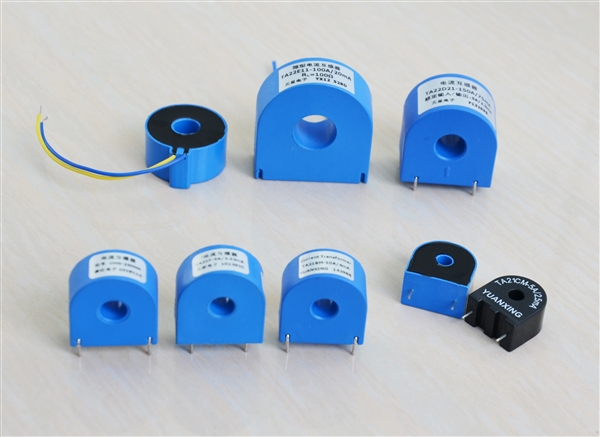
Zero Sequence Current Transformers (PCB Mounting) Image 1

Zero Sequence Current Transformers (PCB Mounting)

Applications

  • Circuit breaker

Features

  • Low cost
  • More than 10 dimensions
  • Asymmetric PCB installation type / lead output type
  • Core material: nanocrystalline or nickel alloy
Download Datasheet

Specifications

  • Internal insulation:
    epoxy potting
  • Dielectric
    strength: 2500V AC/min
  • Insulation resistance:
    1000MΩ @ 500 Vdc
  • Impulse voltage:
    5000V (1.2/50μs standard lightning wave)
  • Rated burden:
    100kΩ
  • Working temperature:
    -25℃ - +55℃ / (optional) -40℃- +85℃
  • Working frequency:
    50 to 400 Hz
  • Accuracy class:
    IEC 61869-2 compliant
  • RoHS compliant

Product Overview

YuanXing Electronics’ PCB-mount Zero Sequence Current Transformers are compact, surface-mount components designed for ground fault detection and residual current monitoring in electronic circuits. They offer excellent linearity and a high sensitivity to very low fault currents, filtering out normal load currents to accurately capture imbalance. The components are epoxy potted for durability, offering 2500V dielectric strength and 5000V impulse protection. With rated inputs up to 200A and RoHS compliance, they provide reliable performance in demanding industrial environments.

Typical Productsа

图片 零件编号 额定输入(A) 变比 频率(Hz) 二次负载(Ω) 精度等级 尺寸(mm) PDF
Zero Sequence Current Transformers (PCB Mounting) Image 1 TA1111 5~30 1000:1
2000:1
2500:1
50 to 400 ≤200 0.1
0.2
0.5
ID-L-W-H 7.0-22.0-18.0-23.0
Zero Sequence Current Transformers (PCB Mounting) Image 2 TA1311 5~80 1000:1
2000:1
2500:1
50 to 400 ≤800 0.1
0.2
0.5
ID-L-W-H 7.0-22.0-18.0-23.0
图片 零件编号 额定输入(A) 变比 频率(Hz) 二次负载(Ω) 精度等级 尺寸(mm) PDF
Zero Sequence Current Transformers (PCB Mounting) Image 3 CTT0150 5-150 1:1000
1:2000
1:3000
1:5000
50 to 400 50-400 0.1
0.2
15-58-23-45
Zero Sequence Current Transformers (PCB Mounting) Image 4 CTT0200 5-200 1:1000
1:2000
1:3000
1:5000
50 to 400 50-400 0.1
0.2
20-68-22-58

Frequently Asked Questions

Honeywell needed a stable and highly accurate way to measure current fluctuations in large commercial buildings. Existing sensors often produced noise and drifted over time, creating errors in smart energy dashboards

Honeywell needed a stable and highly accurate way to measure current fluctuations in large commercial buildings. Existing sensors often produced noise and drifted over time, creating errors in smart energy dashboards

Honeywell needed a stable and highly accurate way to measure current fluctuations in large commercial buildings. Existing sensors often produced noise and drifted over time, creating errors in smart energy dashboards

Honeywell needed a stable and highly accurate way to measure current fluctuations in large commercial buildings. Existing sensors often produced noise and drifted over time, creating errors in smart energy dashboards

Honeywell needed a stable and highly accurate way to measure current fluctuations in large commercial buildings. Existing sensors often produced noise and drifted over time, creating errors in smart energy dashboards